
Why SIP Has Historically Outperformed FD
Over 10 Years
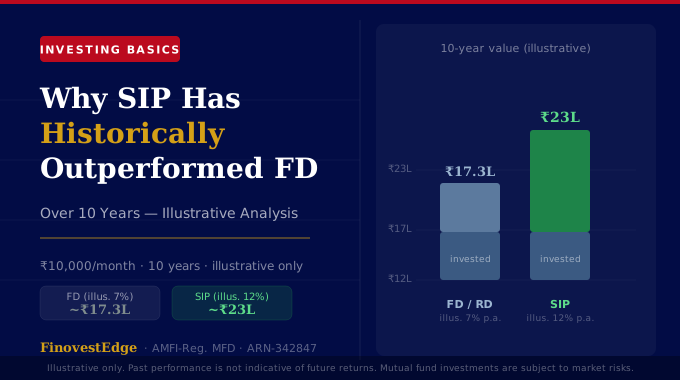
We compared ₹10,000/month invested via SIP (referencing broad equity market historical performance) against a recurring FD over 10 years. The results are striking — though past performance does not guarantee future outcomes.
For educational purposes only. All figures are illustrative and based on historical data — not a recommendation to invest in any scheme. Mutual fund investments are subject to market risks. Past performance is not indicative of future returns. Please read all scheme-related documents carefully before investing.
The Question Every Saver Asks
You've worked hard, you have some money to save every month, and you're faced with the classic Indian household dilemma: Fixed Deposit or SIP?
FDs feel safe. The bank guarantees your money. Your parents trusted them for decades. SIPs, on the other hand, feel like a gamble — "the market can go down" is a phrase that stops many people from starting.
Both concerns are valid. But the data — accumulated over decades of Indian market history — tells a more nuanced story.
This article walks you through how these two instruments have historically performed, why SIPs tend to accumulate more wealth over longer time horizons, and — critically — when an FD is still the right choice.
"The most dangerous investment risk is not market volatility — it is outliving your money by staying too safe for too long."
— Behavioural Finance Principle underlying Goal-Based InvestingUnderstanding the Two Instruments
What Is a Fixed Deposit (FD)?
A Fixed Deposit is a risk-free, guaranteed-return instrument offered by banks and NBFCs. You deposit a lump sum or invest periodically (via Recurring Deposit / RD), and the bank pays you a fixed interest rate — typically compounded quarterly.
FD interest rates in India have historically ranged from approximately 5.5% to 7.5% per annum, depending on the bank, tenure, and prevailing RBI repo rate. Interest earned is fully taxable as income in your hands — at your applicable slab rate. For someone in the 30% tax bracket, the post-tax effective yield can be significantly lower.
What Is a SIP in Mutual Funds?
A Systematic Investment Plan (SIP) is a method of investing a fixed amount into a mutual fund scheme at regular intervals — typically monthly. The amount purchases units of a mutual fund at the prevailing NAV (Net Asset Value).
When you invest via a SIP in a diversified equity mutual fund, your money is deployed across dozens of companies in the Indian economy. Unlike an FD, there are no guaranteed returns. The value can go up or down in the short term. However, historically, broadly diversified equity funds have rewarded patient, long-term investors.
Key Distinction: An FD gives you certainty of capital and returns. A SIP in equity mutual funds offers potential for higher growth alongside higher short-term volatility. Neither is universally "better" — the right choice depends on your goals, time horizon, and risk tolerance.
The Historical Numbers — What ₹10,000/Month Looks Like
Let's look at what ₹10,000 invested every month for 10 years could have historically accumulated to, under two different scenarios. All figures below are illustrative only — they reference broad historical market data and are not projections of future performance.
(same for both scenarios)
Disciplined, uninterrupted
monthly. Pre-tax. Actual rates vary.
historical range). Actual returns vary.
| Parameter | Recurring FD / RD | SIP — Equity MF |
|---|---|---|
| Typical Return (Illustrative) | 6% – 7.5% p.a. | 10% – 14% p.a.* (historical range) |
| Capital Protection | ✓ Guaranteed up to ₹5 lakh (DICGC) | ✗ No guarantee; subject to market risk |
| Inflation Beating Potential | Limited — real return often near zero after 6–7% inflation | Historically yes, over 7–10 year horizons |
| Tax on Returns | Added to income; taxed at slab rate (up to 30%) | LTCG @ 12.5% above ₹1.25 lakh/year (equity, held 1+ yr) |
| Liquidity | Pre-mature withdrawal possible (with penalty) | Open-ended funds: highly liquid (T+2/T+3 redemption) |
| Minimum Investment | Varies by bank; typically ₹1,000+ | As low as ₹500/month |
| Rupee Cost Averaging | Not applicable | ✓ Automatically buy more units when markets fall |
| Power of Compounding | Yes, on fixed interest | Yes — on potentially higher base returns |
| Behavioral Discipline | Auto-debit available; no temptation to redeem | SIP mandate enforces regular investing habit |
| Best Suited For | Short-term goals, emergency fund, senior citizens, risk-averse investors | Long-term goals (5+ years), wealth creation, beating inflation |
* Historical CAGR references are based on publicly available broad market benchmark data (e.g., Nifty 50 Total Returns Index) and do not represent or guarantee the performance of any specific mutual fund scheme. Past performance is not indicative of future returns. Tax rates and rules are subject to change. Consult your tax advisor for personal tax guidance.
Why SIPs Have Historically Built More Wealth — 5 Reasons
The gap between SIP and FD returns is not a coincidence. There are structural, mathematical reasons why equity SIPs have historically outperformed FDs over long time horizons. Here are the five most important ones.
When equity markets fall, your fixed SIP instalment buys more units at lower prices. When markets rise, you hold those units at higher value. This averaging effect means your overall cost per unit reduces over time — a structural advantage that a fixed-return instrument cannot offer.
Both FDs and equity SIPs benefit from compounding. But compounding at 12% p.a. (illustrative equity range) vs 7% p.a. (illustrative FD rate) creates a dramatically different outcome over 10, 15, or 20 years. The difference between these two rates is where long-term wealth gaps are created.
India's average inflation has historically hovered around 5–7% per annum. An FD earning 7% p.a. pre-tax may deliver a real (inflation-adjusted) return close to zero — or even negative after taxes. Equity mutual funds have historically offered real returns meaningfully above inflation over long periods.
FD interest is added to your total income and taxed at your income tax slab rate — up to 30% plus cess. Long-term capital gains (LTCG) from equity mutual funds (held for more than 12 months) are taxed at 12.5% on gains above ₹1.25 lakh per year. The tax advantage of equity can significantly improve post-tax wealth.
The biggest enemy of long-term wealth is investor behaviour — panic selling in downturns, stopping SIPs when markets fall, timing the market incorrectly. A SIP mandate, once set up, runs automatically. It removes emotion from the equation. Our philosophy at FinovestEdge — Creating Edge Beyond Behaviour — is rooted in this exact principle: the investor who stays invested through volatility consistently outperforms the investor who tries to time it.
When an FD is Still the Right Choice
This article is not an argument against Fixed Deposits. FDs serve a critical, irreplaceable role in any well-structured financial plan. Here is when FD is the appropriate instrument — and this is not a comprehensive financial planning recommendation, only illustrative guidance:
FD / RD is typically appropriate when:
- Emergency Fund: Your 3–6 month emergency corpus should be in a liquid, guaranteed instrument. FD or liquid fund — certainty of capital matters here.
- Short Time Horizon (under 3 years): For goals less than 3 years away — wedding, car purchase, down payment — equity market volatility is a real risk. An FD or short-term debt fund may be more suitable.
- Capital Protection Priority: Senior citizens, retirees, or anyone who cannot afford to see their capital fluctuate should prioritise guaranteed instruments. Regular income from FDs can be essential for meeting monthly expenses.
- Low Risk Tolerance: If market volatility causes you anxiety that leads to poor decisions (panic redemptions), a guaranteed instrument may serve you better emotionally and financially.
- Regulatory Safety: FD deposits up to ₹5 lakh are insured by DICGC (Deposit Insurance and Credit Guarantee Corporation), providing a formal safety net.
The ideal approach for most investors: A structured allocation where your emergency fund and short-term goals are protected in FDs/RDs, while your long-term wealth creation goals — retirement, children's education, financial independence — are systematically funded through SIPs in diversified equity mutual funds. This is not investment advice; it is a general framework. Your specific allocation should be discussed with a qualified MFD or financial professional based on your risk profile and goals.
The Behaviour That Determines Your Returns
Here is the often-overlooked truth: the returns of a scheme and the returns of an investor in that same scheme are frequently very different numbers.
Studies consistently show that average investor returns trail the fund's stated CAGR — because investors buy when markets are euphoric and sell when markets fall. The fund performs well over 10 years; the investor, who redeemed in the downturn and re-entered at a peak, earns far less.
This is why we call it "Creating Edge Beyond Behaviour." The mathematical edge of SIP over FD is real — but only accessible to investors who stay the course. The role of a good Mutual Fund Distributor is not just to help you choose an investment, but to help you stay invested when every instinct tells you to stop.
"The stock market is a device for transferring money from the impatient to the patient."
— Warren Buffett (as widely quoted; for educational purposes only)SIPs work because they impose patience by design. You invest a fixed amount regardless of market conditions, removing the psychological burden of deciding "is this a good time to invest?" — a question that derails most retail investors.
The Bottom Line
Over a 10-year horizon, SIPs in diversified equity mutual funds have historically created significantly more wealth than equivalent recurring FD/RD investments — primarily due to rupee cost averaging, higher potential returns, compounding, and better tax efficiency.
This does not mean SIPs are risk-free. They are not. Markets go through extended periods of underperformance. Short-term losses are possible, and even frequent. What history shows is that, for investors with a 7+ year horizon who stay invested through the cycles, equity SIPs have consistently delivered inflation-beating, wealth-creating outcomes.
The right question is not "SIP or FD?" — it is: "What are my goals, when do I need this money, and what allocation across both instruments serves me best?"
That is the conversation we have with every investor at FinovestEdge.
All figures are illustrative only and do not represent any specific scheme's performance. Mutual fund investments are subject to market risks. Past performance is not indicative of future returns. Tax information is general; consult a CA for personal guidance. Published by Finovestedge Distribution Private Limited, AMFI-registered MFD (ARN-342847). We are a distributor, not a SEBI-registered Investment Adviser.
Ready to Start Your SIP Journey?
Understanding is just the first step. The second is acting on it — with a goal-based plan tailored to your income, timeline, and life. Book a free 30-minute consultation with our team.